


Located in San Mateo County, California, the Half Moon Bay Airport (HAF) is one of the most beautiful places to land an airplane anywhere in the world. Arriving or departing, north or south, pilots and passengers soar over stunning scenery as the frigid Pacific meets the rugged cliff walls of America’s west coast. Down below, things aren’t terrible either. Area beaches are gorgeous. The forests are populated by redwoods. Grey whales occasionally spout offshore. World-renowned, big wave surf break, Mavericks, pounds the beach less than a mile from the runway, which is surrounded by residential neighborhoods on three sides. For visitors flying in and out of Half Moon Bay, the flight is every bit as much of a thrill as the destination. For the town’s residents, the experience of having an active airfield as close as a few hundred meters from their home isn’t always pleasant.
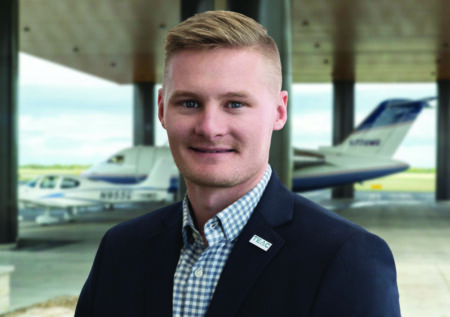
Davi Howard, airport communications specialist for the County of San Mateo, California is responsible for assuaging noise concerns at HAF and the County’s larger reliever airport, San Carlos (SQL), located 20 miles (32km) east on the outskirts of San Francisco.
“The Half Moon Bay Airport is a destination landing for pilots around the world,” says Howard, who has spent a lifetime in aviation. His father, a mechanic for United Airlines, instilled in him a passion for working with his hands. After ten years of service in the US Air Force as an air traffic controller working for the FAA Howard did the same on the civilian side for 26 more years until he was required to retire at age 56. “When I retired, the county asked me to help with a noise abatement program. A growing chorus of noise complaints arose from the communities surrounding the airports. So, the county wanted to get ahead of that.”
Howard took his current position in 2017. Nearly nine years later, the County of San Mateo’s Friendly Approach noise abatement program reflects a growing trend in active noise management at local airports such as SQL and general aviation airports like HAF.

“My job is to monitor aircraft and make sure they are complying with our voluntary noise abatement procedures,” says Howard. The procedures, available through the County’s Friendly Approach website, instruct preferred departures and arrival routes based on vectors for each of SQL’s runways. Importantly, trainers instructing pilots on pattern work, touch-and-go, and other training activities are also provided with specific instructions on preferred flight operations. “In San Carlos, we have a control tower. When the pattern gets busy, it stretches out north and south over homes that aren’t normally overflown. That’s when noise complaints come in.”
Though it’s easy to point out the irony of people buying property next to an airport complaining about the noise, the truth is, in the USA the FAA doesn’t have specific mandatory noise restrictions. Rather, the regulator retains jurisdiction over all of the flights in its airspace and the authorities managing airports. Instead of dictating how aircraft are to be flown quietly, the FAA focuses on noise reduction through research, setting safety standards, and providing a framework for airport noise compatibility planning, guiding best practices. As a retired air traffic controller, when Howard took the job, he understood that addressing noise concerns at the County airports would be a multi-channel matter.
“First, I worked with the County Board of Supervisors, who, as elected officials, needed to better understand how the system works. This helped them explain to constituents what is happening in the air and, more importantly, why,” continues Howard. “Next, we integrated two tracking systems. One tracks complaints and allows us to respond to complainants with specifics once we have them. The other tracks the aircraft themselves using FAA radar technology. This identifies aircraft causing the noise, from which we can extrapolate where it was, how it was flying, who was flying it, and why it was making so much noise.”
Unsurprisingly, the reasons are generally mundane. At SQL, where airspace is constricted, a slowdown on the runway of any duration elongates the approach pattern. At HAF, noise complaints most often arise when a flight-school student is flying circles over the airport. If a plane gets off course or a little low, the noise becomes annoying.
“What the public doesn’t realize is that people can’t fly a 747 without learning to fly a two-seater in circles over a GA airport first,” says Howard, who has logged over 1,000 hours as a general aviation pilot. “When I first took this job, the complaining public was rather hostile. Yelling, saying things like ‘you guys are useless.’ My first goal was dispatching that thought process. So, we got a tent and table and started attending community events to meet people where they are.”
Taking a conciliatory approach, Howard deputizes complainants in communities surrounding San Mateo’s airports. After explaining the county’s ability to track and identify specific noise-producing events, Howard encourages citizens who are bothered not to wait to complain. Instead, file the concern, and he’ll take it to the party responsible.
“When I take these concerns to a flight school or the charters operating out of our airports, they are always 100% receptive,” says Howard. “People working in aviation have highly specialized careers that involve a tremendous amount of detail. So, naturally, they want to follow procedures, especially when they are flying.”
Jason Middleton is one of those on the other end of the conversation. He’s the CEO of Silver Air Private Jets, an aviation management and jet charter company that flies aircraft in and out of SQL, HAF and similar smaller airports around the world. “Voluntary noise abatement programs exist under different names at small airports worldwide,” says Middleton, who co-founded Silver Air Private Jets in 2008. An an aircraft management firm it offers owners a transparent view of their aircraft operations and makes decisions based on the owners’ goals. Jets under management serve as a charter fleet of world-class experiences for members of Flight Club. “We are dedicated to excellence in everything: service, quality, and ease. That includes doing our best to keep noise down, so we can continue to have access to the airports. In Santa Monica, the local airport has been all but shut down to jet aircraft because of noise complaints.”
As both Middleton and Howard know, often there is more to the story than a noise complainant might imagine. In the air and on the ground, real-world conditions dictate how any aircraft is properly flown.
“Wherever there are noise abatement procedures, we do our best to comply. However, safety is number one,” says Middleton. “Foul weather or limited visibility can be factors on departures. Sometimes, landing procedures require a pilot to stay high and take a very steep approach. We have pilots review these procedures as part of flight preparations. However, safety is always first. It won’t be jeopardized to abate noise.”
Asked what he would like program administrators, such as Howard and airports to know about noise abatement programs Middleton is direct.
“Silver Air Private Jets is considered one of the top-tier operators in aircraft management. So, we strive to do everything at the highest level possible,” shares Middleton. “However, industry-wide, noise abatement is something that could be easily overlooked in flight planning. Usually, the noise abatement procedures are on the airport’s website, which is not something pilots and planners look at in flight planning like NOTAMs, weather, and airspace restrictions.”

With the arrival of electric aircraft, Middleton and Howard agree the landscape of business aviation will soon change. Certainly, electric planes will be quieter. Though, like everything else, how they affect people’s lives will be a matter of perspective.
“I’m very excited about electric aircraft,” shares Middleton, who sees opportunity. “When eVTOL aircraft are in operation, they will depart from vertical ports in neighborhoods and fly people across a city like LA in 30 minutes. Tremendous engineering research is being invested in making ultra-quiet propulsion systems. It’s going to be a whole new world.”
Howard agrees on the upside, but wonders about the unforeseen consequences of this brave new world.
“Electric aircraft are going to be awesome. The noise will be less than half that of piston-engine powered aircraft,” he says confidently. “However, due to battery life, the first electric planes are only going to be able to fly for about an hour. So, flight schools will be the first to use them regularly. The eVTOL air taxis will also be quiet. Eventually, they will fill the skies above major cities. So, that will take some getting used to.”
Read the original article here