


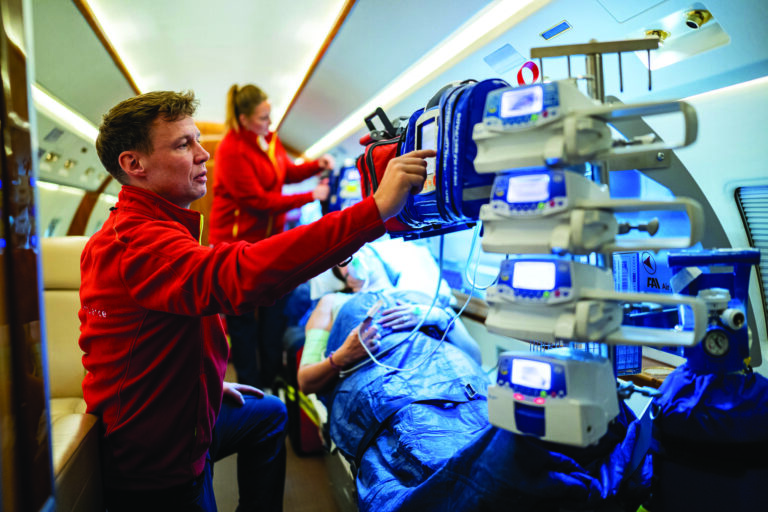
Air ambulance operators face challenges from geopolitics, cross-border friction and unaccredited competitors, but patient care remains the focus for the best providers
The transport of patients requiring medical attention by air is a specialized business, with additional layers of complexity compared to corporate or VIP transport, commercial or cargo. Ongoing medical attention must be delivered during the flight, whether it is an air ambulance medical evacuation, or medevac, or a more controlled patient transport.
Volker Lemke, managing director of Germany-based FAI medical services has been with the company since 2004, at which time it had just three aircraft. Today it has access to a fleet of 17 aircraft for its air ambulance operations. This includes five Lear Jet 60s with a range of 2,200 miles (3,889km) that are fully dedicated to Air Ambulance services. There are five Bombardier Challenger 604s which for 99% of the year fly as Air Ambulances and have a range of 3,500 miles (6,296km). Finally, there are seven Bombardier Global Expresses, which have a range of 6,922 miles (11,140km). These are rarely used for medical transport, perhaps once a year.
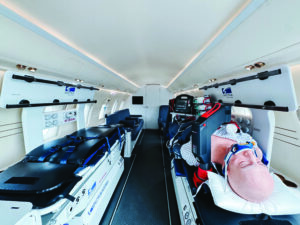
Reconfiguring jets from corporate VIP to medical transport is not complex. “Two seats come out of the Lear 60 and a medical bay is built in. You must have covers on the seats and the carpet because you may get patient blood or vomit on them. Even so it takes two or three hours,” says Lemke.
“But we prefer dedicated aircraft. Medical staff and patients don’t give the right level of care to a business jet’s interior, they just see it as an ambulance, so things can get get marked and chipped when patients and equipment are being loaded and offloaded.”
Planning differences
Planning for medical missions is very different from corporate and VIP flights. Lemke says, “Long range business often has a lead time of five to seven days. With air ambulance it is usually between two and 24 hours.
“But we have advantages that mean you can get all the necessary clearances to fly a mission in just a few hours.”
Most aviation authorities and international regulators recognize medevac flights as priority operations, which streamlines administrative and air traffic processes. The next hurdle is the crew. Lemke says, “For the ambulance business every day we have seven crews on standby, plus an additional five medical crews on standby and a paediatric neonatal team. It’s around 40 pilots and 60 medics.
“Crews have a lead time of one hour to be at the airport. Preparation of the aircraft, checking the medical equipment, is another one and a half hours. Two and a half hours from mission activation to departure is normal for us.”
Political difficulties
FAI Medical’s operation is efficient and well-practised, but like other medevac service providers it still faces rapidly changing geopolitical circumstances and war. The company had several years where it was supporting UN peace keeping forces, giving it experience of operating in sensitive and risky destinations. It also has a strong presence in the Middle East, where the current conflict has had an adverse impact on flight planning and logistics.
However, there is opportunity in crisis for those that can adapt. Lemke says, “March was a record month for us out of the last 24 in terms of revenue, because we were able to react immediately to the situation in the Middle East with alternative solutions. We immediately identified Tashkent in Uzbekistan as a new hub.
“So, we avoid the Arabian Peninsula by flying up to Tashkent, change crew then back to Europe. We had flights twice a day between Europe and Asia.”
Tom Hienckes, commercial manager at European Air Ambulance (EAA) agrees that shifting geopolitical tensions cause operational challenges. Route planning becomes complex when sanctions and airspace closures change overnight. For patients, this can mean longer flight times, additional fuel stops or the need to reposition aircraft through alternative corridors. But for clients, it means increased costs.
“We monitor regulatory updates and coordinate closely with authorities and partners,” says Hienckes. “When airspace suddenly closes, you have to find the right route at the right time.
“The patient adds another dimension to working that out. You don’t want random fuel stops in locations where the level of patient care cannot be delivered easily.”
Luxembourg-based European Air Ambulance (EAA) is a non-profit, enabling it to reinvest all its earnings into its operations and equipment. The company does patient transport, organ transport missions or urgent medevacs, which are often launched with just two to three hours of notice. The organization has two Bombardier Challenger 605s and three Learjet 45XRs dedicated to patient transport, a fleet of helicopters and around 25 pilots, 40 doctors and 25 nurses.
Flights are staffed by at least one doctor and a nurse, as well as specialists when needed, operating on a three-shift pattern covering 24 hours. “Three shifts are essential, it gives you the manpower to operate,” says Hienckes. “We have a very low turnover of staff, I think one person has left the company in the last four years.”
Patient care
Managing the patient’s condition is a distinct challenge facing air ambulance providers. A reputable operator will carry out a risk assessment of a patient’s medical condition when taking on a mission. This can impact flight planning. Hienckes gives the example of planning field stops during the winter in Eastern Canada – do you risk a snowstorm or choose a route over the Azores which will take one or two hours more? The risks to the patient must be considered.
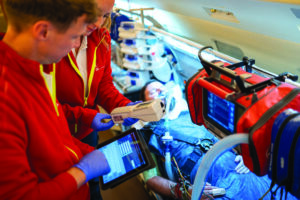
A patient’s condition can also deteriorate during a mission. Plans may have to change at short notice, for example necessitating overnight stays for the crew while a patient’s condition stabilizes. “We have all the intensive care transport devices on board possible, we can cover nearly every event, but we are not a flying intensive care unit like some of our competitors might claim to be,” says Lemke.
Cowboys and accreditations

Regulation for the medevac sector varies throughout the world. According to Lemke in Germany anyone with an aircraft on the tarmac and medical experience can provide an air ambulance service.
Individual clients, who will be in stressful and pressured situations, may be vulnerable to less scrupulous operators. Hieneckes says, “In very desperate situations, especially if families or private persons are going to pay for the ambulance themselves, they can be misled by websites.”
Hieneckes shies away from calling for more regulation of air ambulance services and points out that certification costs money. “The people that do the audits have the knowledge, but it’s still linked to a payment. It is still commercially driven,” he says.
“There are a lot of operators that have mixed operations with aircraft they convert to fulfil missions. Although that may be okay, the question with a mixed configuration is what is the priority?
“You cannot do cargo, VIP charter, ambulance, aircraft, over the flights. An aircraft is optimized for each use-case. A mixed-use air ambulance cannot provide a high-quality service,” says Hieneckes.
However, he points out that although the patient uses the service and is the primary focus, they are often not directly paying for the service. “Our actual clients are the assistance companies, NGOs, and governments who contract our services, not the patients themselves,” he says.
Around 80 to 90% of EAA’s air ambulance work comes from assistance companies, because behind assistance companies are large insurers, which fund the missions and will do due diligence on operators.
The industry also has its own systems in place: “Every quality player is going to have accreditation, either CAMTS [Commission on Accreditation of Medical Transport Systems] in the USA or the European Aero-Medical Institute.
Both do audits every three years and we just did ours, it is extremely tough, they investigate everything,” says Lemke.
Eva Kluge, managing director of European Aero-Medical Institute (EURAMI) agrees that major travel assistance companies recognize the importance of accreditation but points out that these companies do not specialize in aviation and are focused on outcomes, not operational capabilities. She says, “We provide an objective assessment of safety, quality, governance and operational readiness that individual buyers would struggle to conduct themselves.
“The area that still concerns me is when certain brokers use opaque and potentially misleading practices, particularly within the self-pay air ambulance sector. Greater transparency across the industry would benefit everyone, especially patients,” says Kluge.
Cross-border friction
A EURAMI audit starts with a documentation review. The on-site component can last several days and assesses compliance across operational, clinical, safety and quality-management requirements. Any failings are discussed with the applicant, which has up to three months to implement corrective actions. Accreditation lasts for three years.
Kluge says, “Initial findings can often relate to organizational structure, documentation, implementation of processes or aviation training requirements. But our approach is not simply about compliance, we promote continuous learning and the sharing of global best practices.”
EURAMI currently has 60 members around the world with the majority split between North America and Europe. As well as accreditation it represents the interest of air ambulance providers when cross-border friction occurs.
Recently, operators have had difficulty repatriating US and Canadian patients from Mexico, particularly from places such as Cancún, Puerto Vallarta and Toluca. Kluge says, “Incidents have included the detention of medical crews and the confiscation of equipment and licensed medications.”
According to Kluge, new Mexican regulations have not been consistently implemented and conflict with international ones that prioritize humanitarian and medical flights. In response, EURAMI has established a dedicated task force to engage with regulators and industry stakeholders to seek practical solutions.
“Progress is being made, and we are hopeful that the situation will improve in the near future,” she says.
eVTOLs and drone medevac
Like all of aviation, air ambulance is evolving with new technologies. Several eVTOL makers, including the USA’s Joby, and unmanned drone companies, such as Switzerland’s Dufour, are aiming for the medevac and patient transport with their aircraft.
Lemke believes the short range and restricted payloads of most of these new concepts limit their applications. “With medical you have double the flight crew and all the equipment. The payloads are not sufficient.
“I don’t see them for trips under 400 miles, which are typically done by ground ambulances. Hybrid-electric or hydrogen may open more markets because the carbon footprint is less, but I don’t see a massive change in the market,” he says.
EAA is following the development of eVTOLs but does not plan on replacing its fixed wing aircraft with eVTOLs in the near future. “On the other hand, we have been running a pilot project for the past two years in which we use drones to transport blood samples within Luxembourg. We are looking to expand this project, so we are already investing in and gaining experience with drone operations,” says Hienecke.
He adds that although the operational expertise to provide such services can be learnt, the conclusion of the project was that there was “still a lot of work to be done in terms of the regulatory framework.”
Kluge is more positive about the potential for eVTOL and unmanned platforms. She says she can envision creating accreditation standards for these aircraft in the future. “eVTOLs are already being used in conflict zones such as Ukraine, for example, for patient transport missions. In Iceland, similar technologies have been explored for search-and-rescue applications, although not yet for patient transport,” she says.
However, she agrees limited payload and ranges restrict their suitability for many traditional air ambulance missions. “That said, medical air taxi services could prove particularly valuable in regions where islands are located close to the mainland, such as parts of Southeast Asia, the Caribbean and Latin America.
“As technology matures and regulatory frameworks develop, we expect eVTOLs to become an increasingly important part of the aero-medical ecosystem.”