


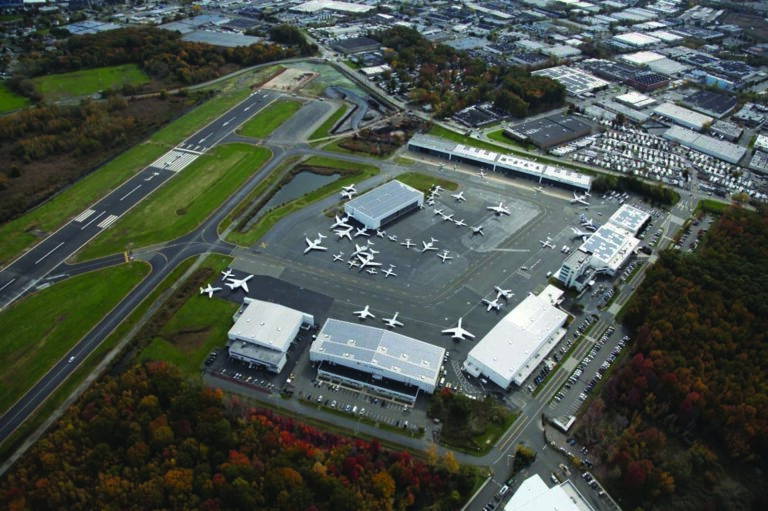
Located in Teterboro, New Jersey, Teterboro Airport (TEB) is remarkable in three ways. First, it is the oldest operating airport in the New York City metro area. Second, Teterboro caters to business and general aviation; no commercial carriers are permitted. Third, TEB is the only airport fully owned and managed by the Port Authority of New York & New Jersey.
“What truly sets us apart is our exclusive focus on private and business aviation, no scheduled commercial flights, and strict aircraft weight limits capped at 100,000 lbs,” says Sherri Smith, manager of Teterboro Airport.
“This allows us to maintain a highly specialized, efficient environment. With top-tier fixed-base operators and full customs services onsite, we ensure our visitors experience privacy, speed, safety, and convenience.”
Offering this kind of service evidently matters to TEB’s clients. “Teterboro is the busiest private jet airport in the United States, underscoring our vital role in business aviation,” Smith says. “In 2023 alone, we handled approximately 171,000 aircraft operations — about 85% of which were private jets.”

There’s a fourth reason why Teterboro Airport is a successful business airport — namely, its close proximity to downtown New York City. It is located just 12 miles (19km) away from midtown Manhattan. Granted, LaGuardia is closer at 9 miles (14km) from midtown, while Kennedy is about 20 miles (32km) away, but it caters to commercial airlines as well as business and general aviation. Hence, for business aircraft travelers who prioritize efficiency, Teterboro is their obvious first choice.
“Access from Manhattan to Teterboro is very straightforward, usually a 20 to 30 minute drive,” says Smith. “We’re well connected by major roadways and positioned to serve as a fast and convenient entry point to the New York metro area. Looking ahead, we’re excited about the potential of eVTOL aircraft. We believe these eVTOL vehicles could revolutionize how passengers travel between Manhattan and Teterboro, dramatically reducing transit times. We’re actively exploring how to integrate this new technology into our operations as the market evolves.”
Over a century of service
Occupying 827 acres with two runways in service, Teterboro Airport was originally a mix of marsh and swampland. Its existence changed radically in 1917, when Walter C. Teter purchased the land with an airfield in mind. Two years later, the first flight took off from Teterboro, and a new chapter in aviation began. In 1926, Colonial Air Transport worked out of Teterboro, becoming the first private air mail carrier in the United States.
“TEB quickly became a center for aviation innovation, hosting key industry figures and companies such as North American Aviation and Anthony Fokker,” Smith explains. “During both World Wars, the airport played a critical role in supporting military operations as a center for aircraft design and manufacturing.” In World War II, Teterboro Airport served as a US Army military base.
“In 1949, the Port Authority took over Teterboro and has since invested over US$450 million in modernization efforts, including upgraded lighting systems, expanded hangars, and sustainability initiatives,” says Smith.
“Today, Teterboro stands as a business aviation facility committed to efficiency and innovation. In recent years, the airport has supported important missions such as a receiving point for organ transplants for regional hospitals We’ve also hosted numerous aircraft demonstrations and have continuously adapted to evolving business aviation trends, keeping Teterboro a key player in the industry.”
There’s a very good reason why TEB is focused on business aviation. This airport is legally prohibited from serving scheduled commercial flights.
“A 1967 weight limit banning aircraft over 100,000 lbs redirected the airport’s focus exclusively to business aviation,” explains Smith. “This role was cemented by federal legislation in 2003.”
There are several factors that prevent Teterboro Airport from supporting commercial flights. TEB is located in a residential area that would be significantly impacted by the noise generated by large airliners. In addition, its runways and other surfaces are not built to handle their weight.
There is a third reason why Teterboro is so focused on business aviation. “The airspace surrounding New York City — served by John F. Kennedy International Airport (JFK), LaGuardia Airport (LGA), and Newark Liberty International Airport (EWR) — is among the most complex and congested in the world, handling approximately 7,000 flight operations per day and over 2.5 million annually,” says Smith.
“The shift toward exclusively serving business aviation came as a strategic solution to alleviate congestion at New York’s major commercial airports. As a designated reliever airport, Teterboro handles general aviation and private jets, freeing capacity at JFK, LaGuardia, and Newark.
“To maintain this focus, we enforce strict policies — no scheduled commercial flights and an aircraft weight limit — to serve the specific needs of business travelers. Our proximity to Manhattan and 24/7 operations add unmatched convenience for our corporate and private clients.”
Doing it all for business aviation
With 143,097 business jet flights in 2024 alone, Teterboro is the busiest airport for US private jet operations. This is not surprising given TEB’s proximity to Manhattan and its absence of scheduled commercial passengers.

Quality of service also matters in business aviation, especially among the VVIP clients who own private jets. To keep them coming back, “we prioritize the complete experience for business travelers,” says Smith.
This includes TEB being home to three fixed-base operators. Collectively, the FBOs manage five private terminals offering personalized concierge services, aircraft maintenance, and luxury amenities to business travelers. The presence of US Customs and Border Protection services onsite also streamlines international flights into Teterboro.

That’s not all, with upgrades to infrastructure also helping the airport grow. “A major enhancement was the commissioning of a new air traffic control tower in late 2023, which enhanced safety and significantly improved operational efficiencies and management of our unique airspace,” Smith says. “Unlike commercial airports, where airlines coordinate with the FAA, our users interact directly with air traffic controllers, so this upgrade was essential. Finally, we’ve made substantial infrastructure investments, including modern hangars, advanced airfield lighting, and sustainability initiatives like solar energy expansion and electrification of ground support equipment. “Our focus with our upgrades is always on delivering safety, privacy, and operational efficiency from arrival to departure.”
The next 108 years
If we take 1917 as Teterboro Airport’s official birthday, this facility has been in continuous operation for over a century. So, what does the Port Authority have planned for the next 108 years?
“Teterboro’s strategic vision is centered on maintaining its status as the region’s premier business aviation hub,” says Smith. “To achieve this, we’re continuing to invest in infrastructure, technology, and sustainability initiatives that align with industry trends and client expectations. To date, over US$450 million has been invested in facility upgrades, and we remain committed to continuous improvement.
Planned enhancements include expanded hangar space, upgraded airfield systems, and modernized support infrastructure to accommodate growing demand.
“Sustainability is a top priority for us at Teterboro,” she adds. “We’re expanding solar energy use, shifting to electric ground service equipment, and preparing for next generation aircraft like eVTOLs.
“At the same time, we’re working to expand access to general aviation through targeted outreach and broader commercial engagement, keeping Teterboro competitive and inclusive.
Our commitment to operational excellence, safety, and strong industry and community relationships ensures Teterboro remains a vital part of the regional and national business aviation network.”
Teterboro Airport seems to be well-positioned for whatever the future may hold.
As Metro New York City gets larger and more congested, the value of its proximity to Manhattan will grow as the years go by. And should the promise of eVTOLs as urban air taxis come to fruition, TEB’s usefulness is bound to increase.
Imagine being able to fly above traffic from Manhattan directly to Teterboro in a matter of minutes!
With eVTOLs becoming reality, some day this may be possible — and eventually routine.