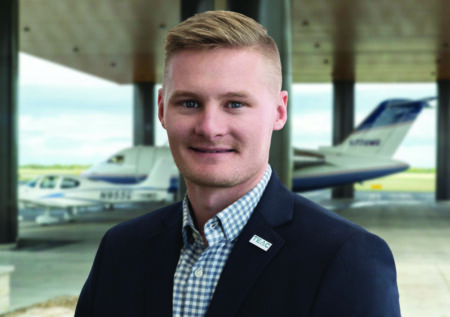



What was your path into business aviation?
My path into business aviation is pretty untraditional. Aviation honestly wasn’t even on my radar.
My introduction came through a former college basketball teammate who was close friends with the brand manager, Jamie Muñoz, at a Dallas-based FBO. As a small-town kid from New Mexico with big dreams of becoming a sports broadcaster, aviation wasn’t the plan, but I said yes to a meeting and drove to Love Field.
From the moment I walked into the facility, I was hooked. The building was beautiful, the lobby was buzzing, and the aircraft on the ramp made it feel like I had stepped onto a movie set. What I expected to be a quick interview turned into a conversation about my goals and ambitions. She listened, then took the time to explain the FBO, Part 135 operations, and the repair station.
As we wrapped up and I headed for the elevator, she stopped me and said, “Just so you know, if you get into this industry, it’s addictive.” I definitely thought she was a little crazy. A week later, I got a job offer to start on the flight line. I graduated college on a Saturday, moved from New Mexico to Dallas on Wednesday and started work that Monday. And let’s just say, I’ve been in it ever since. She was right and now I’m stuck!
Was there a particular moment or person that inspired your career direction?
I was drawn almost immediately to the fast-paced, ever-evolving, relationship-driven nature of business aviation. But the moment that truly shaped my career direction came early on, less than a year into the industry, during a simple and unexpected conversation with Jamie.
We had just finished pulling an aircraft out to the back forty of the ramp. As we sat on the tug, she turned to me and said “you know, you could run this place one day… if you wanted to”. I remember looking at her in total disbelief, thinking, yeah right! Me?

What followed was both inspiration and affirmation. Jamie told me plainly that if business aviation was where I wanted to stay, she saw real potential ahead for me. She reminded me that with continued hard work and my passion for others, she could see me one day running a company within the industry. That conversation changed the way I viewed my future and forever shifted how I saw my own capabilities.
Jamie became my first true mentor, pushing me further than I ever thought possible. She embodies servant leadership and stayed deeply invested in my development. I was also fortunate to work closely with Connie Brown at EPIC Fuels, now with Atlantic Aviation, who brought that same care and leadership, expanding my understanding of the industry and encouraging me to chase bigger goals. I’ve been incredibly lucky to have many mentors throughout my career. Now, it’s my turn to give back and help others recognize their own potential.
What problem is ENG Aviation trying to solve?
One of the biggest challenges we’re focused on is keeping up with the growing need for dedicated aircraft for organ recovery. Since policy changes that happened in 2021, transplant teams can travel farther than ever before, and advances in organ perfusion devices mean organs can last longer than we thought possible. That progress has been incredible, but it has also created a much greater demand for aviation support that can move quickly, safely, and often with very little notice.
What makes our approach different is how we meet that need. We partner with aircraft owners when they’re not flying their own personal missions and allow their aircraft to go to work for a greater purpose of saving lives, all while generating revenue to offset asset costs. It’s a model that creates access to dedicated lift without sacrificing safety or reliability.
The need is only growing. In 2025, the USA completed just under 49,000 transplants, with a goal of reaching 60,000 by the end of 2026. With nearly half of those transplants requiring air transportation, having dependable aviation in place isn’t optional, it’s essential to making these life-saving missions possible.
Part of my role is also educating the transplant community on FAA regulations, operational standards, and what questions they should be asking when partnering with an air carrier. When they understand how we operate and why compliance matters, it leads to safer missions and better outcomes for patients.
What’s a recent challenge that tested you?
Aviation is expensive, and on the management and transplant side especially, you quickly realize you’re not just providing a service. You’re educating, guiding, and sometimes rebuilding confidence. Many aircraft owners have been burned before they meet us. They come in guarded, understandably cautious, and sometimes skeptical. That’s not something you fix with a quick explanation or a polished presentation. It takes consistency, patience and showing up the same way every time. Understanding the long game is key, and as long as you stick to your values and do things right, success will come.

What’s one aspect of business aviation operations that you think deserves more attention?
The perception around business aviation deserves more attention. So often it’s seen as a luxury for the 1%, but that narrative misses the heart of what this industry really is.
At its core, it’s about time. These aircraft are tools. They allow people and companies to move quickly, make critical decisions face-to-face, respond to urgent situations — and get home to their families sooner.
Time is the one thing you can’t get back, and this industry is built around protecting it.
Since being part of ENG and the mission-driven work we do, I’ve seen a completely different side of business aviation. We’re not just flying organs. We’re delivering hope with urgency and safety, every single time. That’s a story that deserves a bigger spotlight. There are so many meaningful, life-changing missions happening in this space, and I believe we need to do a better job sharing them and shifting the lens on what this industry truly represents.
Where is business aviation getting it wrong?
If I could change one thing tomorrow, it would be the ‘this is how we’ve always done it’ mindset.
For a long time, success in this industry meant get in, keep your head down, work the hours, work overtime, work when you’re sick, and don’t worry too much about balance. But we now have a new generation stepping into leadership roles and we value excellence and sustainability. We want to build meaningful careers without sacrificing our health, our families, or our sense of purpose. If we don’t evolve with that shift, we risk losing really talented people.
I also think business aviation has been the best-kept secret for far too long. Many aviation schools focus almost exclusively on Part 121 pathways, but we aren’t doing enough to showcase the range of opportunities within business aviation beyond just the flight deck.
We’ve started to move the needle, but if we want business aviation to become one of the most sought-after careers, we have to be more intentional about culture, visibility, and how we define success.
What does the NBAA YoPro Council do?
The NBAA YoPro Council is a group of driven, forward-thinking professionals from every corner of aviation who have come together with the goals to support, inspire, and elevate the next generation in this industry. We work across several focus areas, including Professional Development, Marketing and Events, and Advocacy, and we’re intentional about pushing things forward. We care about meaningful progress while embracing new technology, adapting more quickly where it matters, and creating real opportunities for young professionals to grow. This council gives emerging leaders a genuine seat at the table and the opportunity to influence where business aviation is headed all while building lasting connections. It’s truly a go-to community for support, visibility, and momentum in your career.
What does business aviation need to do differently to retain your generation’s talent?
I think one of the biggest barriers for young professionals in business aviation is clarity. Many come into the industry excited, but don’t always see a clear path forward or what opportunities exist beyond their current role. When that visibility isn’t there, it’s easy to feel stagnant.
Another challenge is culture. My generation values mentorship, transparency, flexibility and feeling like our ideas matter. If we’re stepping into environments where innovation is slowed down by ‘that’s how we’ve always done it’, it can feel discouraging. We want to contribute, not just observe.
Business aviation needs clear career pathways, strong mentorship programs, and leadership that welcomes new perspectives. If we create spaces where young professionals feel heard and challenged, they won’t just stay, they’ll lead.